For most of the past fifty years, placing a dental implant came down to three things: a dentist’s hands, a flat X-ray, and a lot of trained judgement. The drill went where experience said it should go. That approach worked, and in skilled hands it still does. But it carried a margin of error patients never saw and rarely thought about. A nerve sitting a millimetre closer than the image suggested. A sinus floor thinner than a two-dimensional film could reveal. Bone that looked solid on screen and turned out to be soft once the surgeon was in.
Digital implant dentistry shrinks that margin before anyone picks up an instrument. The surgery gets rehearsed on a screen first, in three dimensions, using a scan of your actual jaw. By the time you are in the chair, the hard decisions have already been made.
That shift is what people mean by digital dental implants in Melbourne, and it has quietly changed how the safest implant work gets done. Here is what the technology is, what the evidence says about it, and how it fits with getting an implant placed without paying a premium for the privilege.
What “digital” actually changes
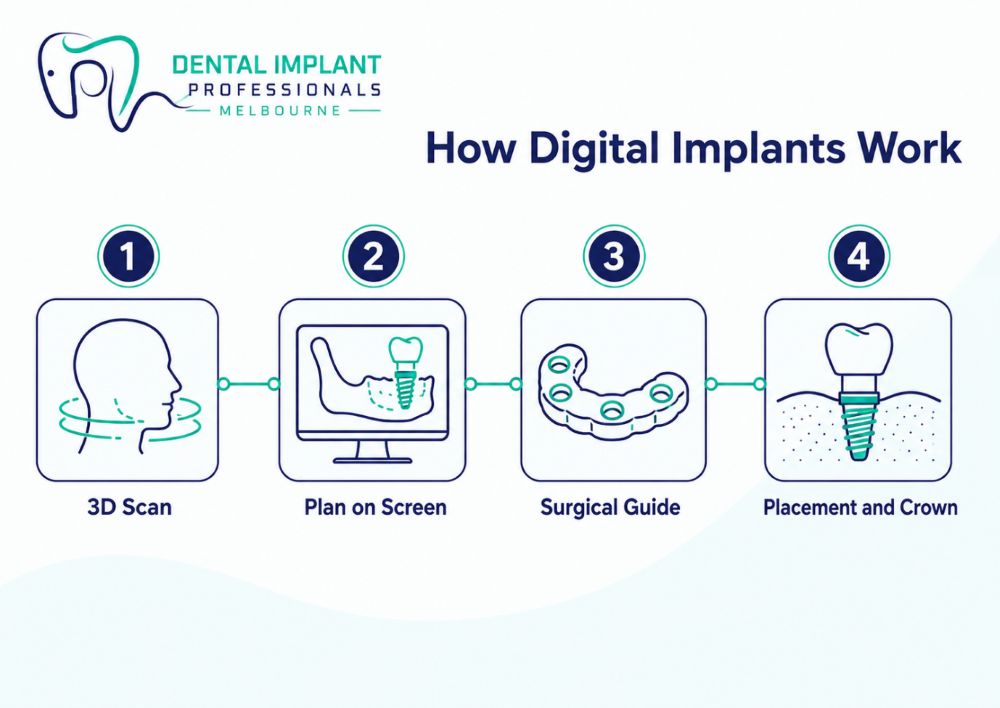
Strip away the marketing and a digital implant workflow has four stages.
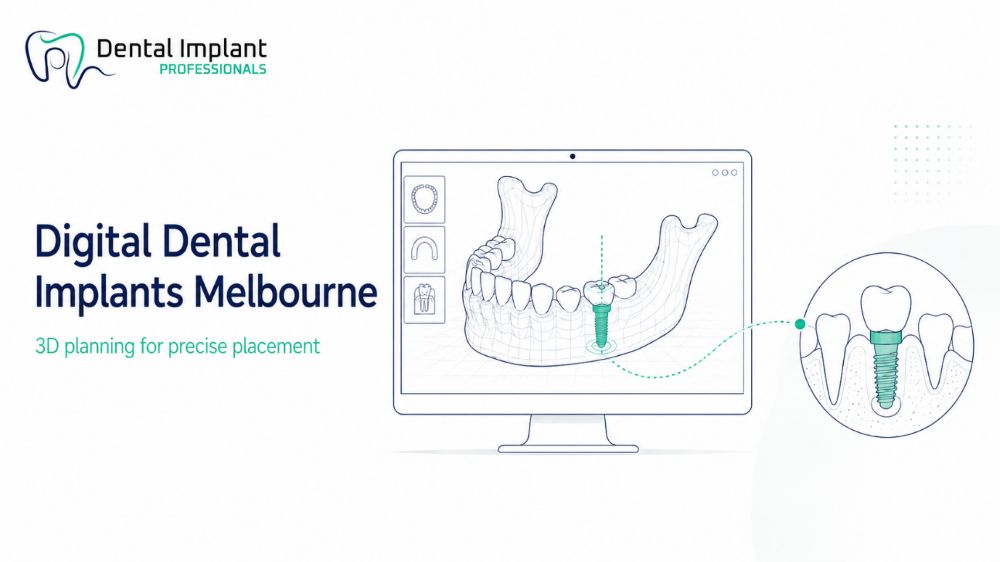
First, a three-dimensional scan of the jaw. Second, planning the implant position on a computer, where the surgeon can rotate the jaw, measure bone, and see exactly where nerves and sinuses sit. Third, in some cases, a surgical guide printed to match that plan. Fourth, the placement itself, followed by the crown that replaces the visible tooth.
Most of the value lives in the second stage. A flat X-ray flattens everything, including the things you most need to avoid. A 3D plan does not. The surgeon decides the angle, the depth, and the exact spot while looking at a model of your anatomy rather than guessing from a shadow.
The scan: seeing the jaw in three dimensions
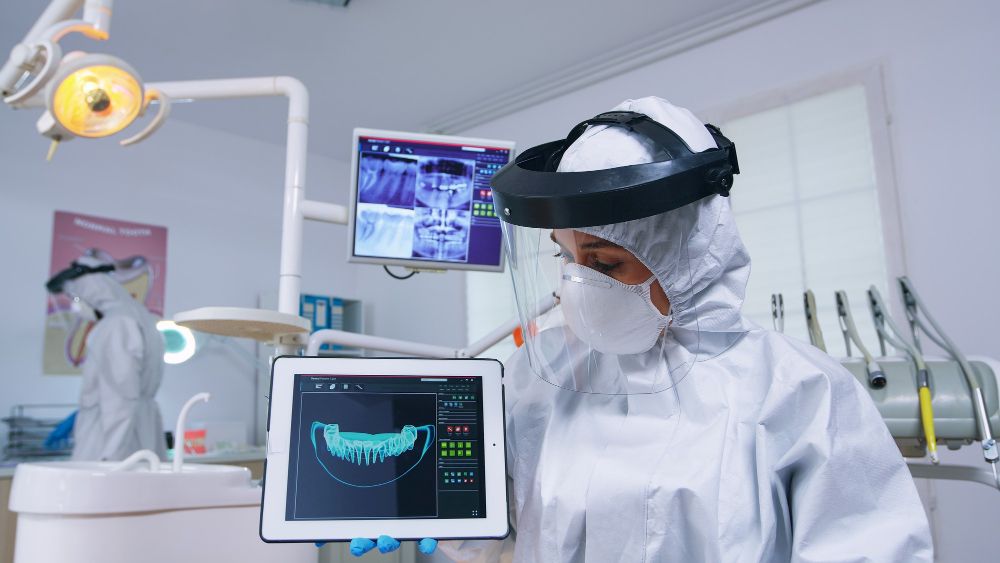
A cone beam CT scan, or CBCT, is the foundation of 3D implant planning. It rotates around your head for a few seconds and builds a three-dimensional picture of bone, nerves, and sinuses that a standard dental X-ray cannot match.
Why does that matter so much? Two structures decide where a lower-jaw implant can safely go: the inferior alveolar nerve, which runs through the mandible, and the mental nerve where it exits near the chin. Clip either and you risk numbness or tingling that can last months or, in rare cases, longer. In the upper jaw, the maxillary sinus sits just above where implants often need to be placed. A 3D scan maps all of this precisely, then measures bone height and density so the right implant size is chosen the first time.
The limitation of older imaging is not abstract. Relying on panoramic X-rays alone carries roughly a 7 per cent chance of misreading the jaw, because a flat film distorts distances depending on the angle. Three dimensions remove most of that guesswork.
This is also the part of digital dentistry the clinic already practises. Before any surgery, the team runs an in-depth examination of your jawbone and the structures around it, including nerves and sinuses, using imaging that takes in a CT scan, so those structures are identified and avoided rather than discovered mid-procedure.
A scan carries more detail than most patients realise, and it is worth understanding what a 3D dental implant scan actually shows before you sit down for a consultation.
The scan settles another question early: whether there is enough bone to hold an implant at all. If the jaw is too thin or too soft in the planned spot, the surgeon knows before surgery that a graft may be needed, and can plan for it rather than improvising. Patients who lost a tooth years ago often have less bone than they expect, because bone shrinks once the tooth root that stimulated it is gone. Seeing that in advance turns a nasty surprise into a scheduled step.
Finding it early is the point, because it turns the question of whether you need a bone graft for dental implants into a planned step rather than a setback discovered mid-surgery
Guided implant placement: rehearsing the surgery
Once the plan exists, it can be carried into the mouth two ways. A static surgical guide is a printed template that sits over the gum and channels the drill along the planned path. Dynamic navigation tracks the drill in real time on a screen, a bit like GPS for the handpiece. Both are forms of guided implant placement, and both exist for one reason: to make the implant land where it was planned.
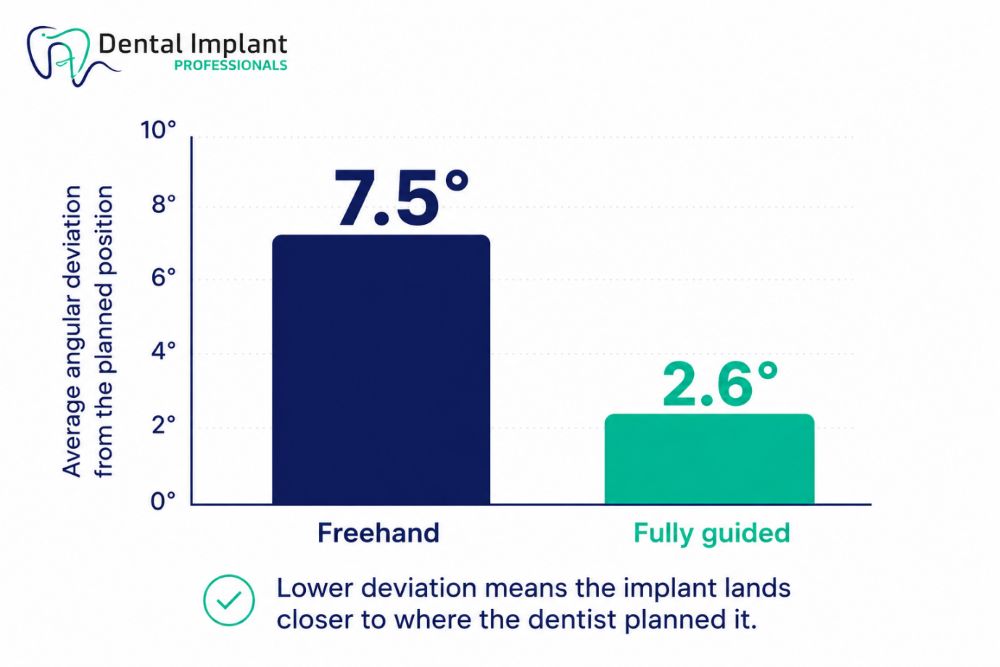
The accuracy difference is measurable. A 2025 systematic review and meta-analysis comparing the methods found that freehand placement deviated from the planned angle by an average of about 7.5 degrees, while fully guided placement cut that to roughly 2.6 degrees, with smaller errors at the entry point and the tip too. In millimetres at the depth of a nerve, that gap is the difference between routine and complication.
Where guidance helps most, and where it doesn’t
Guidance is not a cure for inexperience, and it is not always necessary. The honest reading of the research says so plainly. An umbrella review of thirteen systematic reviews concluded that guided and computer-assisted placement improves accuracy and can lower surgical risk in complex cases, while freehand placement stays reliable, with comparable long-term results, when an experienced clinician does it.
So the value of going digital scales with difficulty. A single implant in a straightforward gap with plenty of healthy bone may turn out beautifully either way. Tight anatomy, thin bone, a sinus to work around, or a full arch of implants planned together is exactly where rehearsing on a screen earns its keep. A good surgeon uses the tool when the case calls for it rather than treating it as a gimmick to upsell.
What it means once you are in the chair
For the person actually having the implant, the payoff is less drama. When the position is settled in advance, there is less guessing during surgery, often less time in the chair, and a crown that fits the way it was designed to because the implant sits where the restoration expected it. Planning around nerves and sinuses also lowers the odds of the post-operative numbness and swelling that worry most patients.
None of this removes the basic facts of surgery. Any invasive procedure carries risk, and a second opinion from a qualified practitioner is always worth seeking. What the digital approach offers is fewer surprises, which is a fair thing to want when someone is drilling into your jaw.
It also helps to know the implant is not finished in a day. After the post goes in, the bone needs time to fuse around it, usually somewhere between two and six months depending on your healing and how much bone was involved. A temporary tooth can often be worn in the meantime, so you are not left with a visible gap. Once the implant has integrated, the abutment and the permanent crown go on, colour-matched to the teeth around it. Planning the position well at the start is what makes that final crown sit naturally instead of fighting the bite.
Knowing the dental implant recovery timeline in advance takes much of the worry out of the weeks that follow, from the healing phase to the day the permanent crown goes on.
Affordable does not have to mean cut-rate
Here is the part that surprises people: better planning and better materials do not have to come with a luxury invoice. The fear that keeps patients away is cost, and the figures floating around the industry feed it. A single tooth implant can run anywhere from $1,500 to $7,000 depending on the clinic, with crowns and abutments billed on top.
For anyone weighing up a single tooth dental implant in Melbourne, the numbers are a sensible place to start.
Affordable dental implants in Melbourne are priced more simply at the Dental Implant Professionals service. The implant fixture, an Australian certified and approved titanium post, is $1,500. The crown, made in recognised Australian labs, is $1,350. A full dental implant, surgery and crown together, comes to $2,850 with no hidden costs and a free consultation to start. The crowns carry a five-year warranty, and the implants come from established manufacturers such as MIS, Straumann, and Ankylos.
Price is only half of the value question. The other half is how long dental implants last, which comes down to the materials used and the care that follows.
There is a reasonable question buried in those numbers. If the implant brand and material are the same Australian-approved components most clinics use, and the price difference between them is often no more than a hundred dollars, why do some clinics charge thousands more? Often the answer is overheads and marketing rather than anything in your mouth.
The overseas temptation
A lot of Australians do the maths on local dental work and start looking at a flight instead. Cheap overseas implants are everywhere, marketed on price alone, and on price alone they can look unbeatable.
The trouble shows up later. An implant is not a one-day transaction. It is months of healing, follow-up, and adjustment, and if something goes wrong with an implant placed overseas, the surgeon who placed it is on the other side of the world. The standards that govern Australian clinics, the accountability, and the ability to walk back in for a review are not extras. They are the difference between a problem you can fix and one you cannot. The risks of getting a dental implant overseas are worth reading before booking a flight, especially when local prices are closer than the brochures suggest.
Getting it done in the heart of Melbourne
The work happens at a dental implant clinic in Melbourne’s CBD, on the ground floor at 350 Collins Street. The team is made up of Australian-registered dental surgeons, all members of the Australian Dental Association, who have placed more than 4,500 implants across fifteen years. The rooms are open seven days a week, which makes the planning visit and the surgery easier to fit around a working life.
Choosing where to have an implant placed is partly about the technology and partly about who is holding the instrument. Seeing an experienced dental implant surgeon in Melbourne’s CBD, in the centre of the city, with the planning and the placement under one roof, is the whole idea behind the Collins Street rooms.
Book a consultation
Getting a high-quality, carefully planned dental implant in Melbourne is now affordable. Book your free consultation with the team at 350 Collins Street, or call 1300 721 184 to talk through your options. No hidden costs, just a clear plan for your smile and a price you can see before you commit. Book your free consultation now.
Frequently asked questions
What are digital dental implants?
The implant itself is the same titanium post used in any modern implant. “Digital” refers to how the surgery is planned and placed: a three-dimensional scan of your jaw, planning on a computer, and in some cases a printed surgical guide that carries that plan into the mouth. The aim is to position the implant precisely around nerves, sinuses, and available bone.
Is guided implant placement more accurate than freehand?
On average, yes. A 2025 meta-analysis found fully guided placement deviated from the plan by about 2.6 degrees against roughly 7.5 degrees freehand. That said, an experienced surgeon working freehand on a straightforward case still gets reliable, long-lasting results. Guidance matters most in complex anatomy and full-arch cases.
Does a 3D or CT scan hurt, and how long does it take?
No, it does not hurt. A cone beam CT scan is quick and non-invasive. You sit or stand still while the scanner rotates around your head for a few seconds, and there is no preparation and no recovery time. The radiation dose is low and targeted to the area being imaged.
How much do dental implants cost in Melbourne?
At the Dental Implant Professionals service, a full dental implant, including surgery and the crown, is $2,850 with no hidden costs. The fixture on its own is $1,500 and the crown is $1,350. By comparison, single implants elsewhere can range from $1,500 to $7,000 once crowns and abutments are added. The first consultation is free. You can see the full dental implant cost in Melbourne before deciding.
Are cheap overseas implants worth the risk?
For many people, no. The upfront price can look lower, but implants need months of healing and follow-up, and care placed overseas is hard to review or correct once you are home. Australian clinics work to strict health and safety standards, and local prices are often closer to overseas quotes than patients expect. The risks of dental tourism are worth weighing carefully.