A missing tooth can affect more than the look of a smile. It can change how you chew, speak and clean your teeth. It may also allow nearby teeth to move into the gap over time. For many people, the two main fixed options are a dental implant or a dental bridge. Both can restore function and appearance, but the better value is not always the one with the lower starting price.
This guide compares dental implant vs bridge cost, lifespan, care needs and long-term value, so patients can make a more informed decision with their dentist.
Which Option Offers Better Long-Term Value?
For many suitable patients, a dental implant offers stronger long-term value because it replaces the missing tooth without relying on the neighbouring teeth. Healthdirect Australia notes that a dental implant can feel like a natural tooth and does not involve the other teeth.
A bridge may still be the better choice when the patient wants a faster treatment, has health concerns that make surgery unsuitable, or has nearby teeth that already need crowns. The Australian Dental Association also notes that not every person is able to have an implant, and alternatives such as dentures and bridges should be discussed with a dentist.
Dental Implant vs Bridge: Cost and Value
| Factor | Dental Implant | Dental Bridge |
| Upfront cost | Usually higher | Usually lower |
| Treatment time | Often longer | Often quicker |
| Nearby teeth | Usually left untouched | Often filed down for crowns |
| Jawbone support | Helps replace the tooth root | Does not replace the tooth root |
| Cleaning | Similar to a natural tooth | Needs careful cleaning under the bridge |
| Long-term value | Often higher for suitable patients | Good short to medium-term value |
A bridge may look more affordable at first. Yet value should also include replacement costs, cleaning difficulty, risk to supporting teeth and how long the restoration is likely to last.
What Affects Dental Implant Cost?
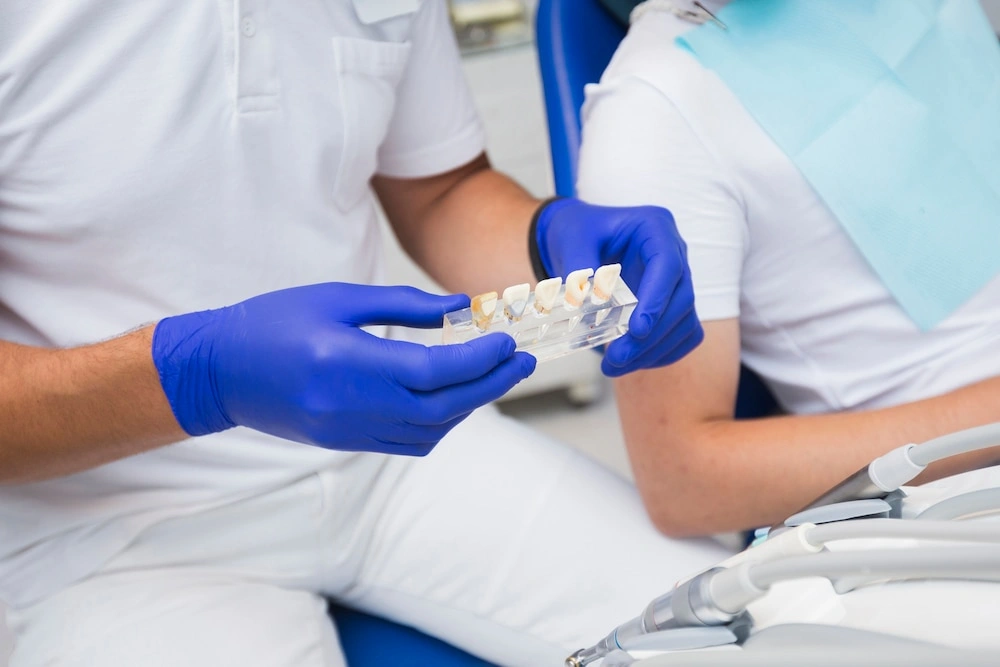
The overall dental implants cost can be hard to interpret because no two cases are exactly the same. The final fee may depend on:
- The number of teeth being replaced
- Whether tooth extraction is needed first
- Bone quality and whether grafting is required
- The type of implant, abutment and crown used
- X-rays, 3D scans or surgical planning
- The clinician’s training and the location of the practice
- Follow-up care and maintenance appointments
An implant is more complex than a bridge because it includes a small post placed in the jawbone, followed by a connector and a crown. That process takes more planning and time, yet it can provide an independent replacement tooth that does not use adjacent teeth for support.
What Affects Dental Bridge Cost?
A dental bridge is fixed in place and attached to teeth on either side of the gap. Healthdirect explains that a usual bridge procedure involves placing crowns on the teeth next to the gap, with another crown acting as the false tooth. It also notes that two healthy teeth are usually filed down to prepare the bridge.
Bridge pricing may vary based on:
- The number of missing teeth
- The type of bridge used
- The material, such as porcelain, zirconia or metal alloy
- The condition of supporting teeth
- Whether decay, gum disease or root canal treatment must be managed first
- Laboratory and appointment fees
A bridge can be a sensible option, especially when the supporting teeth already need crowns. It can also be useful for people who prefer to avoid surgery.
Cost Over Time: The Part Patients Often Miss
The lower upfront price of a bridge can be appealing. Still, the long-term picture may look different. A bridge depends on the health of the teeth holding it in place. If one of those teeth develops decay, cracks or gum problems, the whole bridge may need attention.
Cleaning also matters. Healthdirect advises that floss cannot pass between joined bridge crowns in the usual way, so patients may need superfloss, floss threaders or interdental brushes.
Implants also need regular care, but they do not require filing down neighbouring teeth. Dental implants can last longer than alternatives such as bridges and dentures, with the implant itself potentially lasting a lifetime when cared for with brushing, flossing and regular dental visits. The crown attached to the implant may still need replacement later.

Which Looks and Feels More Natural?
Both treatments can look very natural when designed well. A bridge fills the gap with a fixed false tooth, while an implant replaces the missing tooth root and supports a crown.
Patients often describe implants as feeling closer to a natural tooth because they are anchored in the jaw. Bridges can also feel comfortable, but they work as a connected unit rather than as a standalone tooth.
Pros and Cons
Dental implant pros
- Does not usually require reshaping nearby teeth
- Can help preserve jawbone structure
- Feels stable and natural for many patients
- Often offers strong long-term value
Dental implant cons
- Higher starting cost
- Requires surgery
- Treatment may take several months
- Not suitable for every patient
Dental bridge pros
- Often lower upfront cost
- Faster treatment in many cases
- No implant surgery required
- Can work well when neighbouring teeth need crowns
Dental bridge cons
- Adjacent teeth are often filed down
- Cleaning can be more involved
- May need replacement sooner
- Does not replace the missing tooth root
What is the Best Option for Replacing a Missing Tooth?
The best option for replacing missing tooth depends on oral health, budget, bone condition, gum health and personal preference. For a healthy adult with enough bone, an implant is often the stronger long-term investment. For someone who wants a quicker, non-surgical option, or whose neighbouring teeth already need crowns, a bridge may be more practical.
The right answer should come after a full dental assessment, not from price alone.
Final Verdict
A dental bridge may be the more affordable option at the start. A dental implant often gives better value over time for suitable patients because it works independently, protects neighbouring teeth and may last longer with good care. The smartest choice is the one that balances upfront cost with lifespan, comfort, cleaning needs and future dental risk. Are all on 4 dental implants worth it? We compare longevity to bridges and dentures.
Frequently Asked Questions:
Is a dental implant more expensive than a bridge?
Yes, in many cases. A dental implant usually costs more at the beginning because it involves surgical placement, a connector and a custom crown. A bridge often has a lower starting price, although future replacement or repair costs should also be considered.
How long does a dental bridge last?
Dental bridges often last at least five to seven years, and they may last more than 10 years with good oral hygiene and regular dental care.
Are dental implants worth it long term?
For suitable patients, dental implants can be worth the higher initial fee. They replace the missing tooth independently, do not usually affect nearby teeth and can offer strong durability with regular maintenance.
Which is better for one missing tooth, implant or bridge?
An implant is often preferred for one missing tooth when the patient has healthy bone and gums. A bridge may be better when surgery is not suitable or nearby teeth already need crowns.
What is the cheapest way to replace a missing tooth?
A removable denture is often cheaper than both an implant and a fixed bridge. For fixed treatment, a bridge is commonly cheaper upfront, while an implant may provide better long-term value.
Ready to compare dental implants and bridges for your own smile? Book a free consultation with Dental Implant Professionals Melbourne to discuss your tooth replacement options, costs and long-term value.